





Silicone Hose
Product Specifications
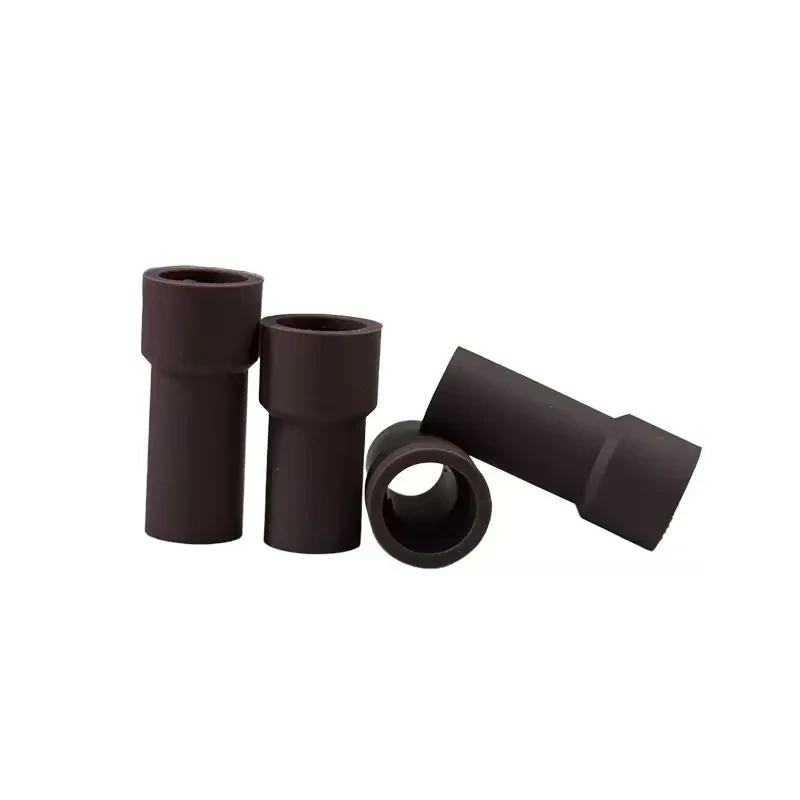
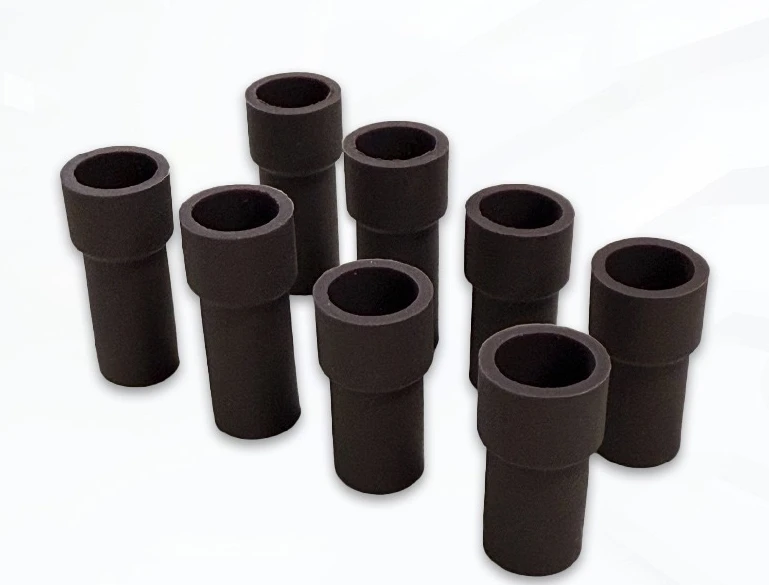
The silicone hose is a short, straight-section silicone rubber sleeve molded with a raised shoulder or flange at one end - a flanged silicone hose / flanged silicone sleeve / step-down silicone tube / cable protection boot. Unlike a plain continuous-length silicone tube sold by the meter, this part is a molded, fixed-length sleeve with an integral flange that locates against a panel, hole or mating component, so the sleeve cannot slide through or slip off after installation. The bore is through and open at both ends, allowing a cable, wire, tube, sensor or shaft to pass through; the flexible silicone wall stretches slightly for push-on installation and then hugs the part it protects. The dark brown color is a high-temperature food- or industrial-grade silicone (VMQ), matte smooth on the outside and free of seams, with uniform wall thickness around the flange and the barrel. This form is widely used as a wire and cable protection boot, a terminal and connector insulator, a mechanical shaft or rod cover, a sensor and switch protection sleeve, an appliance internal lead protector and an automotive harness grommet boot.
Full parameters:
|
Item |
Detailed Parameters |
|
Product Name |
China Silicone Hose, Flanged Step-Down Silicone Rubber Sleeve, High Temperature Flexible Silicone Tubing for Cable Protection, Wire Insulation, Mechanical Boot and Sensor Cover, Dark Brown, Custom ID OD Length Wall Thickness |
|
Shape and Profile |
Straight cylindrical short sleeve with through bore; one end (or both ends on request) has an integral raised shoulder flange / step that locates against a panel or hole; barrel diameter smaller than flange diameter; both ends open; optional tapered, threaded, flared or barbed end profiles; custom length, flange height and step ratio per drawing or sample |
|
Material |
Platinum-cured food-grade silicone (VMQ) or peroxide-cured industrial silicone; optional FKM (Viton) for oil and fuel resistance, NBR for oil and general industrial use, EPDM for water and outdoor exposure; virgin compound, no reclaimed rubber; the dark brown color is a standard high-temperature silicone |
|
Bore (ID) |
Inner diameter 2-50mm on standard tooling; larger IDs up to 100mm on request; bore tolerance ±0.2mm on small IDs, ±0.5mm on large IDs; bore sized so the sleeve stretches 5-15% over the cable, wire or tube it must grip |
|
Wall Thickness |
1.0-5.0mm standard; 0.5-8.0mm on request; thin walls for flexible slip-on fit and tight sealing, thick walls for abrasion resistance and structural protection; wall thickness uniform around the bore and through the flange |
|
Hardness (Shore A) |
30-70 Shore A, standard 40±5; softer for stretch fit and conformable sealing, firmer for abrasion and cut resistance; tolerance ±5 Shore A |
|
MOQ and Lead Time |
Standard sizes (dark brown, common IDs): MOQ 500 pieces, ships 7-10 days; custom ID, OD, length or color: MOQ 1,000-3,000 pieces per size (mold fee applies, partly refundable on volume orders); new tooling 10-20 days; sample lead time 5-7 days; OEM and ODM supported |
|
Packaging |
Bulk in PE bags labeled with part number, material, color, ID x OD x length, wall thickness, hardness, quantity, batch and date; reinforced cartons; fumigation-free export pallets; sleeves protected from compression and sharp edges; custom retail packaging and carton markings available |
Product Introduction
The silicone hose is a molded, short-section silicone sleeve with a through bore and an integral shoulder flange at one end. Its job is to protect whatever passes through its bore - a cable, wire, tube, sensor or shaft - while the flange locates the sleeve against the panel, hole or mating component it passes through. A plain silicone tube cut to length can slip sideways through a hole, slide off a connector or rotate on a shaft; the flange removes that. When the sleeve is pushed onto a cable or rod, the flexible silicone wall stretches just enough to let the part pass, then contracts and hugs it. The flange on the end rests against the outside of the panel or the shoulder of the mating part, so the sleeve stays in place without adhesive, clamps or ties. Installation is push-on and removal is pull-off, which makes the sleeve reusable and serviceable. Because the whole part is molded in one piece - barrel, bore and flange together - there is no seam, no glued joint and no thin spot where a cut tube would eventually split.
The dark brown material is high-temperature platinum- or peroxide-cured silicone. Silicone stays elastic down to -60℃ and holds up to continuous +220℃ service, far beyond PVC, rubber and ordinary plastics used for sleeving; it is also an excellent electrical insulator, resists ozone and UV aging, and can be supplied in food grade. The short length and fixed flange mean this is not continuous tubing sold by the meter - it is a finished, ready-to-install protective boot sized to a specific hole, cable bundle or shaft. Buyers specify the bore so the sleeve grips the cable it must hold, the flange OD so it seats against the panel, and the length so it covers exactly the segment that needs protection. The result is a clean, fitted, reusable protective sleeve instead of loose tubing, heat-shrink or taped-up harness runs.
Core Selling Points
This page emphasizes integral shoulder flange that locks position + stretch-on flexible silicone fit + dark brown high-temperature silicone (-60 to +220℃) + through-bore protection for cables and shafts + one-piece molded seam-free construction + reusable push-on installation as the differentiated angle.
Integral shoulder flange - no sliding through, no slipping off, no extra fasteners: The raised flange at one end is the key difference between this sleeve and a plain cut length of silicone tube. When the sleeve is pushed through a panel hole, over a connector or onto a shaft, the flange seats against the outside face and stops the sleeve from sliding through or drifting out of position. No adhesive, hose clamp, cable tie or tie-wrap is needed to hold it. For harness and appliance makers this removes a manual fastening step, and for end users it means the protective boot stays where it is installed over years of vibration and thermal cycling. The flange is molded together with the barrel, so it will not tear off under repeated push-on and pull-off service.
Stretch-on fit - grips the cable or shaft without glue, reusable: Silicone's elasticity lets the bore stretch 5-15% over the cable bundle, connector or shaft it must cover, then contract to a snug fit. There is no need for adhesive, heat or tooling to install: push it on by hand, pull it off by hand. If a harness has to be serviced, the boot comes off intact and goes back on; it is not a one-time heat-shrink or glued-on part. The snug bore also keeps dust, water splashes and lubricants out of the covered segment, and protects wires and rods against abrasion where they rub against panel edges or moving parts.
Dark brown high-temperature silicone - -60 to +220℃ continuous: The dark brown material is a high-temperature silicone that stays flexible from -60℃ to +220℃ continuous service, with short excursions to 250℃. This is the reason the sleeve works near engines, heating elements, oven cavities, lamp housings, soldering stations and industrial furnaces where PVC, ordinary rubber or plastic sleeving would turn brittle, soften or off-gas. The dark brown color itself is a visual cue for high-temperature duty - different from standard red or translucent general-purpose silicone. Silicone also resists ozone, UV and weathering for outdoor and under-hood use, and is odorless and tasteless when food grade is specified.
One-piece molded construction - no seam, no thin spot, uniform wall: The barrel, bore and flange are molded as a single part, so there is no glued seam along the wall, no welded joint around the flange and no cut end that frays or splits. Wall thickness is uniform through the barrel and around the flange, so flexing and abrasion load is spread evenly. Compared with extruded tubing cut to length and separately flared - which often leaves a cut end that splits, an uneven flare and a seam at the flange - the molded sleeve holds its shape, stays smooth at the ends and survives repeated installation cycles. The smooth bore also means it slides over wires without scraping insulation.
Through-bore protection for cables, terminals, shafts and sensors: Because both ends are open, the sleeve works wherever something must pass through a panel hole or exit an enclosure: a power and signal cable passing through a metal bulkhead, a wire exiting a lamp or appliance housing, a sensor probe emerging from a box, a lever or shaft emerging through a panel, a terminal block lead that needs insulation where it runs near a metal edge. The flange seals the outside of the hole, the barrel shields the wire or rod along its exposed length, and the flexible silicone absorbs vibration between the protected part and the sharp panel edge. This is the reason the same short flanged sleeve is found across appliance, automotive, lighting, machinery and medical applications.
Solutions for Buyer Concerns
Factory-direct pricing and low MOQ for custom sizes: As a silicone mold shop we control compound preparation, mold making, compression molding, trimming and inspection in-house. Standard dark brown stock sizes (common IDs) price lowest, MOQ 500 pieces, ships 7-10 days. Custom ID, OD, length, wall thickness or color: MOQ 1,000-3,000 pieces per size with a modest mold fee, partly credited against volume. Because the flange replaces cable ties and clamps and the sleeve is reusable, per-assembly cost is lower than taped or heat-shrunk protection.
Rigorous quality inspection and certifications: Each lot is checked for hardness, tensile strength, elongation, tear strength and compression set; dimensions (ID, OD, flange OD, length, wall) to ±0.2-0.5mm; visual inspection for voids, flow lines, under-cure, flash and flange defects; electrical volume resistivity for insulating grades; temperature and ozone aging on sampled units. ISO 9001, RoHS, REACH, FDA and SGS reports support customs clearance and customer audits. Every batch is traceable.
Secure packaging and flexible logistics: Sleeves are packed in labeled PE bags - part number, material, color, ID x OD x length, wall, hardness, quantity, batch, date - then in reinforced cartons and fumigation-free pallets. Parts are kept free of compression, dust and sharp edges in transit so the elastic wall is not creased. Custom retail packaging and carton markings are available. Sea, air and express options balance freight and lead time; stock sizes ship in 7-10 days.
Molding and molding-quality craftsmanship: Silicone parts are compression-molded in closed steel molds with controlled temperature, pressure and cure time, so the flange forms cleanly, the bore runs true and wall thickness is uniform. Mold temperature and cure time are set to avoid under-cure (tacky, weak, sticky parts) and over-cure (brittle, cracked flanges). Compared with low-cost sleeves (uneven wall, torn flanges, flash left in the bore, reclaimed rubber smell, undersized flange that does not seat), our sleeves push on smoothly, seat flush against the panel and stay flexible for years. We also provide DFM feedback - radius at the flange, draft angle, gate location - before tooling is cut.
Competitive Advantages and Peer Comparison
There are several common ways to protect a wire, cable or rod passing through a hole, and each has a failure mode. PVC sleeving or spiral wrap is cheap but becomes brittle at low temperature, softens near heat, cracks under UV and offers no location - it slides freely. Heat-shrink tubing seals and bundles but requires a heat gun, shrinks permanently (cannot be reused or serviced), shrinks unevenly over connectors and cannot absorb vibration at a sharp panel edge. Nylon or plastic flanged bushings locate well but are hard and rigid, scratch wires, do not stretch over connectors, have no vibration damping and degrade near heat. Rubber boots and cut rubber tubing are flexible but age poorly in UV and oil, have a cut end that splits, and lack the continuous-use temperature range of silicone. Taping up the hole and harness (vinyl tape, self-amalgamating tape) is a manual, inconsistent operation that unravels, leaves adhesive residue and cannot be removed cleanly. None combines a molded locating flange, an elastic stretch-on bore, continuous -60 to +220℃ service and a reusable push-on fit.
Our silicone hose addresses each of those limits. The integral flange seats against the panel and locks position without adhesive, ties or clamps - unlike plain cut tubing, spiral wrap and tape. The silicone bore stretches over cables and connectors for hand installation and pulls off for service, unlike heat-shrink which is permanent. Silicone stays flexible and elastic from -60 to +220℃, unlike PVC which turns cold-brittle and softens in heat, and unlike rigid plastic which cannot conform to connectors. The one-piece molded wall has no seam, no cut end and no glued flange, so it does not split along a cut or delaminate at a flare. The smooth elastic bore protects wire insulation against the sharp panel edge and absorbs vibration, unlike a hard plastic bushing. And because ID, OD, flange size, length and color are made in-house, the sleeve is matched to the actual hole diameter, cable bundle and exposed segment rather than trimmed in the field. For appliance and lighting makers, automotive harness suppliers, machinery builders, sensor and medical device manufacturers, and DIY model and electronics users, this means a fitted, reusable, temperature-rated protective boot that snaps into place, stays in place and comes off cleanly when service is needed.
Usage, Installation and Maintenance Instructions
Sizing and push-on technique determine whether the flange seats correctly and the bore grips without damaging the cable:
Selection guidelines: Measure the panel hole the sleeve passes through, the outside diameter of the cable, connector or rod the bore must grip, and the length of wire or rod that needs protection. Choose bore ID so the sleeve stretches 5-15% over the cable or rod - too loose and it slips, too tight and it is hard to push on or stresses the cable. Choose flange OD larger than the panel hole so the flange seats on the outside face. Choose wall thickness for the duty: thin walls (1-2mm) for flexible slip-on fit and sealing, thicker walls (3-5mm) for abrasion and cut protection where wires rub. Choose material by environment: standard dark brown high-temperature silicone for general, heat and outdoor duty; food-grade translucent silicone for food equipment; NBR for oil exposure; FKM for aggressive fuel and chemicals. Choose hardness 30-40 Shore A for easy stretch over connectors, 50-70 Shore A for abrasion resistance and structural protection. For insulating duties, confirm required dielectric strength and voltage rating.
Installation guidelines: Inspect the sleeve before fitting - no nicks, cuts or cracks in the flange or barrel. Loosen or temporarily move the cable, if possible, rather than forcing the boot over a bulky connector; where the connector must pass through the bore, choose an ID that stretches over it, or use a lubricant approved for silicone (soapy water is fine; avoid petroleum-based lubricants that can swell silicone). Push the sleeve straight onto the cable or rod, working it along until the flange seats flush against the panel or mating shoulder. Make sure the barrel covers the exposed segment and the sharp panel edge is fully inside the sleeve, not bearing directly on the wire. Route the cable so the sleeve is not twisted, sharply bent or pinched between metal edges. Do not exceed the rated temperature in service; keep the sleeve away from sharp burrs that can cut the wall. For repeated disassembly, pull the sleeve straight off rather than twisting sharply at the flange.
Operation and maintenance: Inspect periodically for wall cuts, abrasion flats, hardening, cracking, swelling from oil exposure, flange deformation or discoloration. Replace the sleeve when the wall is cut through, the flange no longer seats, or the material has hardened and cracked. Clean with water and mild detergent; avoid harsh solvents, petrol-based cleaners and ozone sources. For food-grade applications, clean with food-safe detergents and sanitize per equipment procedures. Store unused sleeves in a cool, dry, dark place away from ozone sources (motors, welders) and sharp objects; do not stack heavy items on them. Shelf life of stored silicone is typically 3-5 years; installed service life depends on temperature, flexing and chemical exposure, but high-temperature silicone commonly delivers 5-10 years in appliance, lighting and under-hood service.
Company Strength Display
We are a specialized silicone rubber molding manufacturer with years of OEM/ODM experience in silicone sleeves, flanged boots, protective grommets, molded silicone parts and custom rubber components for appliance, lighting, automotive, machinery, sensor and medical markets worldwide. Our facility includes compound preparation and color matching, steel mold making, compression molding presses, a trimming and deflashing line, a material laboratory and an in-house QC team, giving us steady capacity and batch consistency for orders from a few thousand pieces to full container loads.
- Production capacity: Daily output tens of thousands of small to medium silicone parts depending on size; steel mold making in-house; new tools in 10-20 days; sample turnaround 5-7 days. Capability covers flanged sleeves, straight tubing, boots, caps, plugs, grommets and custom molded silicone in Shore A 30-70 across red, translucent, black, dark brown and custom colors.
- Certification system: ISO 9001 quality system; RoHS, REACH and FDA 21 CFR 177.2600 (food-grade) declarations; LFGB and UL94 flame-retardant options; SGS test reports on hardness, tensile, elongation, tear, compression set, volume resistivity, temperature and ozone aging. Documentation supports customs clearance and supplier audits in Europe, North America, Southeast Asia and the Middle East.
- R&D and customization: Engineering support on bore stretch, flange seating, length, wall thickness, hardness and material selection for the specific cable, hole and temperature. DFM feedback on draft angle, radius at the flange, gate location and wall balance before tooling. Prototypes approved before mass production; volume pricing with tooling partly credited.
- Packaging capability: Labeled PE bags, reinforced cartons, export pallets, custom labels and carton markings, retail packaging on request. OEM bulk packaging and JIT delivery for assembly lines.
Pre-sales and After-sales Service
Pre-sales Service
Our sales and engineering team advises on bore selection for the cable or rod OD (10-15% stretch target), flange sizing against the panel hole, length for the exposed segment, wall thickness for abrasion duties, hardness for stretch versus durability, and material choice between dark brown high-temperature silicone, food-grade translucent silicone, NBR for oil or FKM for chemicals. We provide free design consultation and, where useful, a dimensional proposal with recommended ID, OD, flange and length before tooling. Stock-size samples are supplied for fit testing; custom prototypes in 10-20 days. RoHS, REACH, FDA and SGS documentation is provided on request. For appliance, lighting and automotive OEMs we support design integration - recommending flange geometry, bore stretch and material grade during product development to optimize fit, temperature resistance and assembly time.
After-sales Service
We stand behind every shipment. For confirmed factory-caused defects - mold voids, uneven wall, torn or undersized flange, flash left in the bore, under-cure tackiness, dimensional error outside tolerance, or material that hardens or cracks prematurely - we replace or refund. Support covers sizing (correct bore stretch for a given cable OD, flange OD for a panel hole), material selection (silicone versus NBR versus FKM for heat, oil or food contact), installation technique (stretch over connectors, flange seating, lubrication), maintenance (inspection intervals, cleaning, storage) and troubleshooting (loose fit, flange not seating, wall abrasion, cracking near heat). For OEM customers: dedicated account management, production priority, proactive material notifications, consignment stock and JIT delivery. For distributors: marketing assets (images, videos, certificates, size charts, selection guides) and listing optimization support. Every lot is traceable by batch; contact support with order number, batch number and photos for prompt resolution.
FAQ
Q1: What is the difference between this flanged silicone hose and plain silicone tubing?
A1: Plain silicone tubing is sold by the meter and has no locating feature, so it slides through holes, slips off connectors and needs ties or clamps. Our sleeve has an integral molded flange that seats against the panel or hole and locks position, and is cut to a fixed ready-to-install length.
Q2: What temperature range can the dark brown silicone sleeve handle?
A2: Standard silicone is rated -60 to +220℃ continuous, with short excursions to +250℃. FKM extends chemical and heat resistance up to +230℃, EPDM suits outdoor and water duty to +150℃, and NBR resists oil to +110℃. Specify the actual temperature and medium on order.
Q3: How do I choose the right bore size for my cable?
A3: The inner diameter should be about 10-15% smaller than the cable or connector OD, so the silicone stretches on and grips snugly. If a bulky connector must pass through, choose a larger bore or a softer (30-40 Shore A) durometer. Send us the cable OD and connector outline and we recommend the ID.
Why Choose Our Silicone Hoses
- Integral molded flange locks position - no ties, clamps or adhesive: The shoulder flange is molded with the barrel, seats against the panel or hole and stops the sleeve sliding through or off, removing a manual fastening step in assembly.
- Stretch-on, reusable push-fit bore: Silicone stretches 10-15% over cables and connectors for hand installation, grips snugly, and pulls off for service without damage - unlike permanent heat-shrink or glued-on boots.
- Dark brown high-temperature silicone, -60 to +220℃: Stays flexible in freezing service and near engines, heating elements, ovens and lamps, resisting ozone, UV and aging where PVC and rubber go brittle or soft.
- One-piece seam-free molded wall, uniform thickness: No glued seam, no cut end that splits, no flared joint that delaminates; smooth bore slides over wires without scraping insulation.
- Six materials and full dimensional customization: VMQ (including FDA food-grade), FKM, NBR, EPDM; bore 2-50mm, OD 4-60mm, length 10-120mm, wall 1-5mm, Shore A 30-70, custom colors - matched to the actual hole, cable and environment.
- Proven quality and factory-direct partnership: In-house mold making, compression molding, dimensional and electrical testing; ISO 9001, RoHS, REACH, FDA options. Stock in 7-10 days, MOQ 500 pieces, tooling in 10-20 days. Free engineering consultation, samples and responsive after-sales.
Hot Tags: silicone hose, China silicone hose manufacturers, suppliers, factory
Previous
Silicone Thread Sealing PlugNext
Rubber AirbagYou Might Also Like


Send Inquiry