




Rubber Foot Pad
Product Specifications
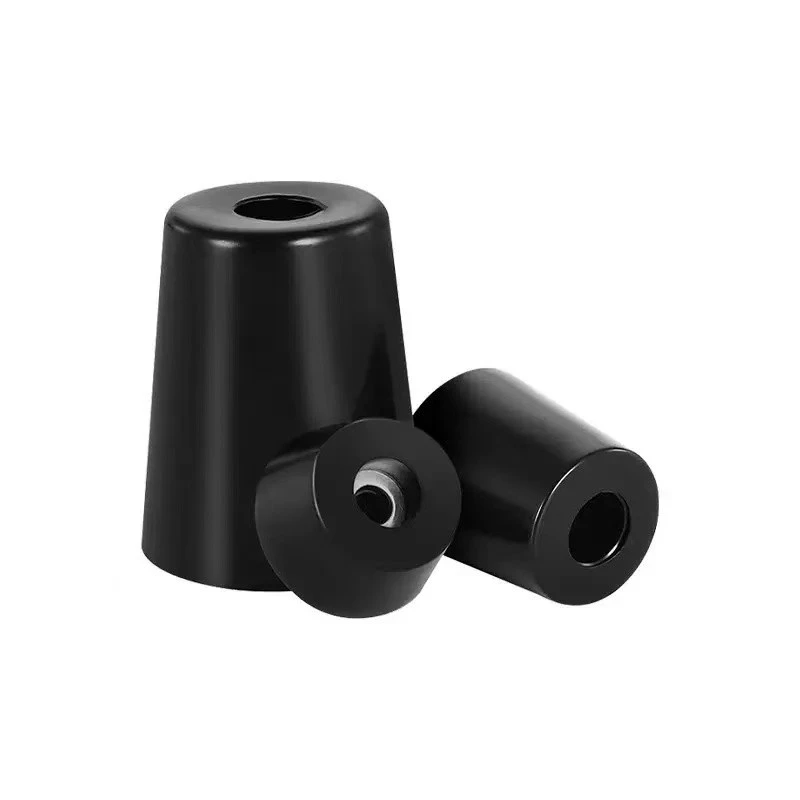
Our factory supplies premium rubber foot pad (tapered rubber feet / cone shaped rubber mounting feet / anti-vibration rubber foot with metal insert) . The tapered (cone) profile gives a large floor contact diameter at the base and a narrower mounting face at the top, so load is spread over a wider area while the foot remains visually compact and resistant to side loads; the metal insert provides a solid, reusable threaded anchor that accepts a bolt from inside the equipment, so the rubber body is never crushed, distorted or stripped by the screw. The foot is installed by bolting through the equipment base into the insert - no adhesive, no drilling jig, no risk of the rubber splitting - and can be removed and reinstalled repeatedly for service or relocation. Standard stock covers three styles visible in the image: tall cone (high clearance, maximum damping), short cone (low profile, compact), and cylindrical (straight body for tight spaces).
Full parameters below:
|
Item |
Detailed Parameters |
|
Product Name |
China Rubber Foot Pad, Tapered Anti-Vibration Rubber Feet with Metal Threaded Insert, High Load Bearing Cone Shaped Equipment Support Pad, Non-Slip & Noise Damping, Black NBR/EPDM/Silicone, M4-M10 Bolt Mounting, for Speaker, Amplifier, Instrument, Cabinet & Furniture |
|
Shape / Profile |
Tapered cone (tall cone and short cone) and cylindrical; top mounting face flat with metal insert; base contact face flat and smooth; cone angle typically 8-15°; custom profiles (stepped, domed, flanged) available |
|
Hardness (Shore A) |
Standard: 60±5 Shore A; Available: 45-75 Shore A in 5-degree increments; tolerance ±5 Shore A; softer grades for maximum damping on light equipment, firmer grades for heavy loads and minimal deflection |
|
Standard Sizes |
Tall cone: base diameter 30-50mm, height 35-55mm, insert M6/M8; short cone: base diameter 25-40mm, height 15-25mm, insert M5/M6; cylindrical: diameter 20-40mm, height 20-40mm, insert M4-M8; intermediate sizes available; custom dimensions from 15mm to 80mm diameter and 10mm to 60mm height |
|
Load Capacity |
Depends on size, hardness and insert: tall cone 60 Shore A typically 30-80kg per foot; short cone 40-60kg per foot; cylindrical 20-50kg per foot; firmer 70-75 Shore A grades support 100-200kg per foot; a four-foot installation on a 200kg cabinet is well within range; specify total equipment weight and support points for confirmation |
|
Surface Finish |
Smooth, semi-gloss black (as shown); matte or lightly textured options available; smooth surface is easy to clean, does not accumulate dust and does not mark floors; no mold release residue on contact surfaces |
|
Color Options |
Standard: Black (as shown); Available: Dark gray, light gray, white, red, blue, brown; custom Pantone matching (MOQ applies); insert finish: brass natural, nickel-plated, stainless steel |
|
Certifications |
RoHS, REACH, ISO 9001, SGS test reports (compound composition, hardness, tensile strength, elongation, tear strength, compression set, insert pull-out force, load bearing, vibration damping, oil and temperature resistance); UL94 V-0 flame-retardant option; FDA food-grade option (silicone) |
|
Packaging |
Standard: bulk in PE bags (100/500/1000 pieces) with labels showing part number, size, thread, hardness, quantity, batch and date; reinforced corrugated cartons; fumigation-free export pallets; custom retail packaging (poly bag with header card, blister, color box), custom carton markings; inserts protected from impact during transport |
Product Introduction
Cone shaped rubber mounting foot is a bolt-mounted support component installed under speakers, amplifiers, instruments, cabinets, appliances and light industrial equipment. Two design elements define its performance. First, the tapered cone profile: the base is wider than the top, so the foot contacts the floor over a larger diameter, lowering contact pressure and improving stability against lateral forces - equipment does not rock or shift when bumped, and the foot resists shear loads better than a straight-sided pad of the same height. The narrowing body also looks clean and compact under cabinets and speakers, and the cone shape allows more vertical deflection for a given footprint, which improves low-frequency vibration isolation. Second, the metal threaded insert: a brass, stainless steel or zinc-plated insert is molded and chemically bonded into the top face, so the mounting bolt threads into metal rather than into rubber. This is the single most important durability difference between a professional foot and a cheap one: when a bolt is driven directly into rubber, the rubber deforms, the thread strips, the foot loosens and eventually splits - and the foot cannot be removed and reinstalled. With a metal insert, the bolt clamps metal-to-metal, torque is controlled, the rubber body stays undistorted, and the foot can be removed, serviced and reinstalled many times without damage.
In use, the foot is installed from inside the equipment: the bolt passes through the equipment base or chassis and threads into the insert, clamping the rubber foot against the bottom panel. Installation takes seconds per foot, requires no adhesive and no special tooling, and the foot is held rigidly in position rather than relying on friction or peel strength. The rubber body then performs its isolation function: it absorbs vibration from speakers, transformers, motors and compressors, converts part of that energy to heat instead of transmitting it into the floor, reduces structure-borne noise and prevents the equipment from marking or scratching the floor. The smooth black surface shown in the image is easy to clean and does not collect dust in texture grooves. Standard stock covers three profiles - tall cone for high clearance and maximum damping, short cone for a low profile under compact cabinets, and cylindrical for tight spaces - all with brass inserts in the common M4-M10 range. Custom sizes, hardness (45-75 Shore A), materials (NBR, SBR, NR, EPDM, silicone, CR), insert materials (brass, nickel-plated brass, stainless steel, zinc-plated steel) and colors are available for OEM programs.
Core Selling Points
Tapered cone geometry - wide base stability, compact top, better shear resistance: The cone shape is not cosmetic. A wide base spreads the load over a larger floor area, reducing contact pressure and the risk of indenting wood, laminate or vinyl flooring; the low, wide stance resists tipping and lateral forces, so equipment stays level when bumped, moved or subjected to vibration; and the narrowing body provides more vertical compliance within a compact footprint, which improves isolation of low-frequency vibration from speakers, transformers and motors. Compared with a straight cylindrical foot of equal height and base diameter, the tapered foot gives a softer spring rate at the top (better damping) while keeping the same stable base. The three standard profiles let buyers match clearance and appearance: tall cone for generous airflow and cable clearance under amplifiers and speakers, short cone for a low, unobtrusive look under cabinets and appliances, cylindrical for confined spaces where a cone would foul nearby structures.
Metal threaded insert - bolt-anchored mounting that will not crush, strip or split: The decisive quality point is how the bolt engages the foot. In cheap rubber feet the screw bites directly into rubber: initial torque deforms the body, the thread strips under load or repeated assembly, the foot loosens, and the rubber eventually cracks around the hole. Our feet use a metal insert (brass standard, nickel-plated brass, stainless steel or zinc-plated steel) that is molded into the rubber and chemically bonded plus mechanically interlocked, so the bolt clamps into metal. The rubber is never compressed by the screw, the mounting height stays accurate, torque can be controlled to a specification, and the foot can be removed and reinstalled repeatedly during service, relocation or refurbishment. Insert pull-out force is tested lot by lot, and the insert is available as a blind female thread (bolt does not protrude into the foot) or a through-bore for pass-through bolts. For outdoor, wet or marine use, stainless steel inserts prevent rust staining on the floor and seizing of the bolt.
Bolt-in installation - seconds per foot, no adhesive, no drilling jig, serviceable: Installation is simply: align the foot under the equipment base, insert the bolt from inside the chassis, and tighten into the insert. There is no release liner to peel, no surface preparation, no cure time, and no risk of adhesive failure under heat or load. The foot is mechanically fixed, so it will not detach when the equipment is lifted, shipped or dragged - a common failure of self-adhesive pads on heavy equipment. Bolted feet are also serviceable: loosen the bolt, replace the foot, re-tighten, with no cleanup of old adhesive. For OEM assembly lines this shortens cycle time and eliminates adhesive consumables and VOC concerns; for end users it makes replacement trivial. Recommended tightening torque is specified per thread size to avoid over-compression of the rubber while ensuring the foot stays secure.
Smooth black surface - clean look, easy cleaning, no floor marking: The semi-gloss black rubber surface shown in the photo is smooth rather than heavily textured. This matters for two reasons: first, dust, lint and cleaning residue do not collect in grooves, so the foot stays clean in showrooms, hospitals, laboratories and homes; second, the smooth contact face does not abrade or scuff flooring the way rough or heavily filled rubber compounds do. The compound is based on virgin rubber with controlled filler content, so it does not bleed plasticizer or leave black marks on light-colored tiles, vinyl or wood - a frequent complaint with reclaimed-rubber pads. The black finish matches most equipment chassis and cabinet colors, giving a finished, professional appearance rather than an add-on accessory look.
Vibration damping and noise reduction - quieter audio, calmer appliances, steadier instruments: The rubber body isolates the equipment from the floor and absorbs vibration energy instead of transmitting it. For speakers and subwoofers, this reduces cabinet resonance and floor coupling, tightening bass and reducing rumble transmitted into the room structure; for amplifiers, transformers and turntables, it reduces mechanical hum transfer; for instruments and medical devices, it reduces measurement disturbance from floor-borne vibration; for washing machines, air conditioners and heat pumps, it reduces structure-borne noise and prevents the appliance from walking. Hardness selection controls the result: softer 45-55 Shore A grades maximize damping for light equipment, while 65-75 Shore A grades limit deflection for heavy loads. Because the foot is bolted rather than merely resting under the equipment, the isolation path stays consistent over time.
Solutions for Buyer Concerns
Factory-direct transparent pricing: As an original rubber manufacturer we control compounding, mold making, molding, metal insert bonding, deflashing, inspection and packaging in-house. Tiered volume pricing with no hidden charges. Standard stock profiles price lowest and ship fastest; custom sizes, hardness and insert materials are quoted by material, size, thread and volume. Because the insert prevents stripping and splitting, total cost of ownership is lower than cheap rubber feet that fail at the mounting hole and require replacement.
Rigorous quality inspection and certification: Each lot is checked for compound hardness, tensile strength, elongation, tear strength and compression set; dimensions (base diameter, height, concentricity, insert position) to ±0.2mm; insert pull-out force and torque resistance; thread gauge check on the insert; load bearing without collapse; vibration damping where specified; and visual inspection for flash, bubbles, cracks, uneven gloss and insert flushness. Full SGS reports, RoHS and REACH declarations and COC with batch traceability are available for customs and customer audits.
Protective packaging and flexible logistics: PE bags of 100/500/1000 pieces with labels showing part number, size, thread, hardness, quantity, batch and date; reinforced cartons; fumigation-free pallets. Inserts are cushioned so threads are not damaged in transit. Custom retail packaging, header cards and carton markings available. Sea, air and express options balance freight cost and lead time; stock profiles ship in 3-5 days.
Precision molding and rubber-to-metal bonding craftsmanship: Compression and injection molding with controlled temperature, pressure and cure time gives consistent hardness, accurate cone angle and a clean surface. Inserts are degreased, primed with a dedicated bonding agent, positioned in the mold and bonded during cure, then mechanically interlocked by the molded profile - so the insert cannot rotate or pull out under torque or load. In-house CNC/EDM mold making keeps cavities accurate and flash minimal. Compared with low-cost feet (reclaimed compound, insert pressed in without bonding, inconsistent hardness, flash and sink marks), our product holds its height, thread and damping performance batch after batch.
Competitive Advantages and Peer Comparison
Support feet differ mainly in how the bolt engages the body and how the profile manages load. Cheap rubber feet with no insert are the most common low-cost option: the screw threads directly into rubber, which deforms under torque, strips when re-tightened, splits around the hole and cannot be reliably reused - and the foot often loosens in service. Plastic feet (PP, ABS, PA) are rigid, transmit vibration almost completely, provide little damping, can crack at the mounting boss and slide on smooth floors. Metal feet (steel, aluminum) are strong and dimensionally stable but transmit vibration and noise directly, scratch floors and provide no electrical insulation. Self-adhesive pads are quick to apply but rely on adhesive that fails under heat, load or repeated lifting; they cannot be used where the equipment is shipped or dragged. Felt, cork and foam pads are soft and protect floors but compress permanently, absorb oil and moisture and provide minimal, inconsistent isolation. Bare equipment bases transmit maximum vibration, mark floors and offer unstable contact. None combines a reusable metal-threaded anchor, a stable tapered profile, reliable damping and a clean appearance.
Our rubber foot pad with metal threaded insert solves the mounting problem that causes most foot failures. The bolt clamps into brass, nickel-plated brass, stainless steel or zinc-plated steel - not into rubber - so the body is never crushed, the thread never strips and the foot can be removed and reinstalled repeatedly. The tapered cone profile gives a wide, stable base with a compact top, improving resistance to tipping and lateral loads while providing more vertical compliance for low-frequency isolation than a straight-sided foot of the same footprint. The smooth black virgin-rubber surface stays clean and does not mark light floors, unlike reclaimed-rubber pads that bleed and scuff. Three stock profiles - tall cone, short cone and cylindrical - cover high-clearance audio equipment, low-profile cabinets and confined installations, and custom sizes, hardness (45-75 Shore A), materials and insert types are available for OEM work. For speaker and audio brands, instrument and electronics makers, appliance OEMs, furniture manufacturers, cabinet builders and light machinery producers, this means a foot that installs faster (bolt-in, no adhesive), stays fixed in shipment, survives service rework, isolates vibration and looks finished - reducing mounting-hole failures, adhesive callbacks and floor-marking complaints.
2.4 Usage, Installation and Selection Instructions
Correct selection, bolt torque and profile choice determine whether the foot isolates vibration, stays fixed and protects the floor:
Selection guidelines: Match the profile to clearance and appearance: tall cone (35-55mm height) for amplifiers, speakers and equipment needing airflow or cable clearance; short cone (15-25mm) for a low profile under cabinets, appliances and furniture; cylindrical for tight spaces. Match the insert thread to the bolt already used by the equipment (M4, M5, M6, M8, M10) - measure the existing screw or check the chassis drawing; do not force a mismatched thread. Estimate load per foot: total equipment weight ÷ number of support points, plus a 1.5-2x margin. Select hardness: 45-55 Shore A for light equipment and maximum damping; 60 Shore A standard for general use; 65-75 Shore A for heavy cabinets and minimal deflection. Select material: NBR standard for indoor equipment; EPDM for outdoor, UV or humid locations; silicone for high-temperature or food-grade applications; stainless steel insert for wet, outdoor or marine environments. For equipment that will be shipped assembled, prefer bolted feet over adhesive pads.
Installation guidelines: Confirm the insert thread matches the bolt; run the bolt through the equipment base by hand for the first few turns to avoid cross-threading. Seat the foot against the base with the cone pointing down and the insert facing the equipment. Tighten with a screwdriver or hex key to the recommended torque: M4 about 2-3 N·m, M5 about 3-5 N·m, M6 about 6-8 N·m, M8 about 12-16 N·m, M10 about 20-25 N·m - enough to clamp the foot firmly without over-compressing the rubber; always follow the equipment maker's specification if lower. Install all feet before setting the equipment down, then lower it onto a level surface and check for rocking; adjust by loosening one foot slightly, or use shim washers under a foot if the floor is uneven. Do not use impact drivers at high torque, which can spin the insert or crack the rubber. Do not substitute a longer bolt that bottoms out in a blind insert - it will not clamp the foot and may damage the insert. For through-bore inserts, use a washer and nut where specified.
Maintenance and inspection: Inspect every 3-6 months on industrial equipment and annually on furniture and appliances: check for compression set (flattening), hardening, cracks around the insert, insert rotation or pull-out, thread damage and oil swelling. Clean with water and mild detergent; avoid aggressive solvents and prolonged oil contact (NBR swells in oil - switch to CR or FKM for continuous oil exposure). Replace a foot when it is permanently deformed, cracked at the insert, or its thread no longer holds torque; a hardened or flattened foot no longer isolates vibration and may let the equipment rock. Keep spare feet for critical equipment. Store spare feet in a cool, dry place away from sunlight, ozone sources and oils; do not stack heavy objects on the rubber bodies. Shelf life: NBR/SBR/CR about 3 years, EPDM/silicone about 5 years under proper storage.
Company Strength Display
We are a specialized rubber and silicone component manufacturer with extensive OEM/ODM experience for global audio, instrument, electronics, appliance, furniture, HVAC and light machinery markets. Our facility houses rubber compounding lines, internal mixers, CNC mold machining centers, EDM machines, compression and injection molding presses, a dedicated rubber-to-metal insert bonding line, deflashing equipment, a material testing laboratory and an in-house QC team - giving us stable capacity and batch consistency for orders from 200 pieces to full container loads.
- Production capacity: Multiple compression and injection presses; daily output 80,000+ pieces depending on size. Stock profiles (black NBR 60 Shore A, brass insert, tall cone / short cone / cylindrical) ship in 3-5 days. In-house mold design and manufacturing (CNC + EDM) in 5-10 days. In-house compounding for custom hardness (45-75 Shore A), colors and materials. Rubber-to-metal bonding line with insert pull-out and torque testing. Secondary operations: cryogenic, tumble and manual deflashing, trimming, thread cleaning and inspection.
- Certification system: ISO 9001 quality system; RoHS and REACH declarations; SGS test reports covering compound composition, hardness, tensile, elongation, tear, compression set, insert pull-out force, load bearing and vibration damping; UL94 V-0 flame-retardant option; FDA food-grade option for silicone. Documentation supports customs clearance and customer supplier audits in Europe, North America, Southeast Asia and the Middle East.
- R&D and customization: Engineering support for custom profiles (cone angle, height, stepped or flanged bodies), custom hardness and damping, custom insert design (blind or through thread, brass/nickel-plated brass/stainless steel/zinc-plated steel, M3-M10 and inch threads), custom colors and finishes, and performance tuning for load, isolation and floor protection. Drawing or sample to production in 10-15 days. Free material and design consultation with DFM feedback on cost and manufacturability.
- Packaging capability: Bulk PE bags, reinforced cartons, export pallets, custom labels and carton markings, retail packaging (header card, blister, color box). Insert threads cushioned and protected in transit. OEM bulk packaging with part-number labeling and JIT delivery for assembly lines.
Pre-sales and After-sales Service
Pre-sales Service
Our sales team advises on profile selection (tall cone, short cone, cylindrical), insert thread and type (blind or through, M4-M10 and inch threads), insert material (brass, nickel-plated brass, stainless steel, zinc-plated steel), rubber material for the environment (NBR, SBR, NR, EPDM, silicone, CR), hardness (45-75 Shore A), load capacity from equipment weight and support points, color and finish, stock availability, MOQ, pricing tiers, lead time, certifications and packaging. We supply free samples (standard stock profiles or custom prototypes) so buyers can verify thread fit, mounting height, damping, floor contact and appearance before placing a bulk order. Regulatory documentation (RoHS, REACH, SGS, UL94, FDA) is provided on request. For equipment and speaker manufacturers we support design integration - recommending foot height, thread and hardness during product development to optimize clearance, stability and noise. For large OEM customers: dedicated account management, consignment stock, JIT delivery and continuous improvement programs.
After-sales Service
We stand behind every shipment. For confirmed factory-caused defects - wrong thread or insert material, insert pull-out or rotation below rated torque, dimensional error, hardness outside specification, cracking at the insert, or surface defects - we replace or refund. Support covers selection, installation, torque, maintenance and troubleshooting: matching thread to an existing screw, choosing profile height for clearance, calculating load per foot, resolving rocking on uneven floors, preventing cross-threading, replacing a stripped insert, selecting material for oil, outdoor or high-temperature exposure and avoiding compression set in storage. For OEM customers: dedicated account management, production priority, proactive material notifications, consignment stock and JIT delivery. For distributors: marketing assets (images, videos, certificates, size charts, selection guides, SDS) and listing optimization support. Every lot is inspected and traceable by batch; contact support with order number, batch number and photos for prompt resolution.
FAQ
Q1: What is the advantage of the metal insert over a plain rubber foot?
A1: The bolt threads into metal, not rubber. The body is not crushed, the thread does not strip when re-tightened, mounting height stays accurate, and the foot can be removed and reinstalled many times. Plain rubber feet often split at the hole and loosen in service.
Q2: How do I choose between the tall cone, short cone and cylindrical profiles?
A2: Tall cone (35-55mm) for amplifiers, speakers and equipment needing airflow or cable clearance. Short cone (15-25mm) for a low profile under cabinets, appliances and furniture. Cylindrical for tight spaces where a cone would foul nearby structures. Use the same profile and height on all support points.
Q3: Which thread size and insert material should I choose?
A3: Match the insert to the bolt your equipment already uses - M4, M5, M6, M8 or M10; inch threads are also available. Brass is standard for indoor use; nickel-plated brass adds corrosion resistance; stainless steel 304/316 suits outdoor, wet or marine environments; zinc-plated steel is the economy heavy-duty option.
Q4: What bolt torque should I use?
A4: Guide values: M4 2-3 N·m, M5 3-5 N·m, M6 6-8 N·m, M8 12-16 N·m, M10 20-25 N·m. Tighten enough to clamp the foot without over-compressing the rubber, and follow the equipment maker's specification if lower. Avoid high-torque impact drivers, which can spin the insert or crack the rubber.
Q5: Can you customize size, shape, hardness, material and insert? What is the MOQ?
A5: Yes. Base diameter 15-80mm, height 10-60mm, cone angle, stepped or flanged profiles; hardness 45-75 Shore A; NBR, SBR, NR, EPDM, silicone or CR; brass, nickel-plated brass, stainless steel or zinc-plated inserts, M3-M10 and inch threads, blind or through type; custom colors. MOQ: stock profiles 200 pieces, ships 3-5 days; custom size or material 1,000-5,000 pieces per size (mold fee, refundable for 20,000+ orders); custom insert 500-2,000 pieces. Custom lead time 10-15 days. OEM and ODM supported.
Why Choose Our Rubber Foot Pads
- Tapered cone profile - stable base, compact top, better shear resistance: A wide base spreads load and resists tipping and lateral forces; the narrow body adds vertical compliance for low-frequency isolation in a small footprint. Three profiles cover high clearance, low profile and tight spaces.
- Metal threaded insert - bolt-anchored, will not crush, strip or split: Brass, nickel-plated brass, stainless steel or zinc-plated steel insert molded and bonded into the body. The bolt clamps into metal, torque is controllable, and the foot is removable and reusable. Insert pull-out force tested lot by lot.
- Bolt-in installation - seconds per foot, no adhesive, fully serviceable: Bolt from inside the chassis into the insert. No release liner, no surface prep, no cure time, no adhesive failure. Feet stay fixed during lifting, shipping and dragging, and can be replaced without cleanup.
- Smooth black virgin-rubber surface - clean look, easy cleaning, no floor marking: Semi-gloss surface does not trap dust and does not bleed plasticizer or scuff light floors. Matches equipment chassis for a finished appearance.
- Reliable vibration damping and noise reduction: High-loss-factor compound absorbs vibration instead of transmitting it - tighter bass and less rumble for audio, quieter appliances, steadier instruments. Hardness 45-75 Shore A lets buyers tune damping versus deflection.
- Proven quality and factory-direct partnership: In-house compounding, molding, rubber-to-metal bonding and inspection; ISO 9001, RoHS, REACH, SGS, UL94 V-0 and FDA options. 80,000+ pieces/day, stock in 3-5 days, MOQ 200 pieces. Free samples, custom design, JIT delivery and responsive after-sales.
Hot Tags: rubber foot pad, China rubber foot pad manufacturers, suppliers, factory
Previous
Rubber AirbagNext
Silicone PlugYou Might Also Like


Send Inquiry